Heaven made my talent, it must be put to use,
A thousand pieces of gold scattered, will come back again.
A few days ago at an internal weekly sharing session,
I talked about the topic of “career planning.”
Sure enough, adults are most interested in the topic “how to make money.”
When I got to that section, everyone put down their phones and discussed enthusiastically.
These past few days I’ve thought it over a few more times.
My understanding of the topic “how to make money”
is really “my concept of money.”
Tonight might be a suitable time
to use a suitable posture
to write it down in a blog post.
Wealth in my understanding
is made up of family inheritance, labor income, investments, and risk return — multiple components.
Family Inheritance
Some people use their whole life to heal their childhood.
Some people use their childhood to heal their whole life.
Class theory is a viewpoint that has recently become loud.
After decades of wealth accumulation since the founding of the nation,
luck, opportunity, and struggle have led to different wealth accumulations across families.
But putting aside the inflammatory views that intensify conflict,
“all men are created equal, but some are more equal” is a solid fact.
In the game “Total War: Three Kingdoms” there’s a setting:
different factions have different base family wealth.
For example, Liu Bei from selling straw mats — though descended from Prince Jing of Zhongshan —
has no inheritance, with 0 family income per turn.
Yuan Shao of Hebei, four generations of Three Excellencies above him,
not to mention his inherited territory, just his family inheritance income per turn is 4,000.
Humans are the same.
Not to mention those “born with a golden key” like Wang Sicong, Yao Anna, Pan Rui,
even students sitting in the same classroom attending the same class,
will find after graduation
that the gap in family background really is hard to close with just decades of struggle.
When we talk about personal money,
family inheritance is really a topic that has to be faced head-on.
Labor Income
“I heard you can make 10K+ a month after a three-month IT training, is that true?”
“It can be true.”
《The Lianjia Guy Asked Me: I heard you can make 10K+ a month after a three-month IT training, is that true?》
Labor as the most glorious is a traditional virtue of the Chinese nation.
The vast majority of programmer friends’ income comes from labor,
i.e., coding.
Because adults care most about making money,
in places where programmers gather everyone discusses salary, bonus, and raises.
But besides calculating the 996 hourly rate,
I rarely see anyone quantitatively calculate the money conversion rate of labor.
Actually you can use the idea of integration
to estimate the order of magnitude that a modern programmer can earn through labor in a lifetime.

👆 “Coding is youth-only food. Bio-chem-environmental-materials people get better with age.”
We use the orange line (coder) salary curve in the picture above, and try to make a very rough estimate:
- Assume each gray horizontal line represents a 50K annual salary difference
- Assume the coder peak annual salary at age 38 is 480K
- Then the coder’s starting salary at age 22 is roughly 220K
- Working healthily for 50 years, at age 70 the annual income is 250K
Under this rough estimate, it’s easy to draw a conclusion:
Programmer (coder) friends’ lifetime labor income is on the order of tens of millions.
You can try to make a rough order-of-magnitude estimate yourself.
You can even add settings like “996 grind for three years,” “income cliff at 35,” or “early retirement at 40” —
you’ll get similar answers.
Even though 10 million is tens-of-millions order
and 80 million is also tens-of-millions order,
just on the order of magnitude:
A programmer working healthily for a lifetime,
labor income is roughly tens-of-millions order.
So many programmer friends being dissatisfied with their salary
might be that they’re in a more cramped youth stage,
or their ideals are broader than the tens-of-millions scale.
Investments
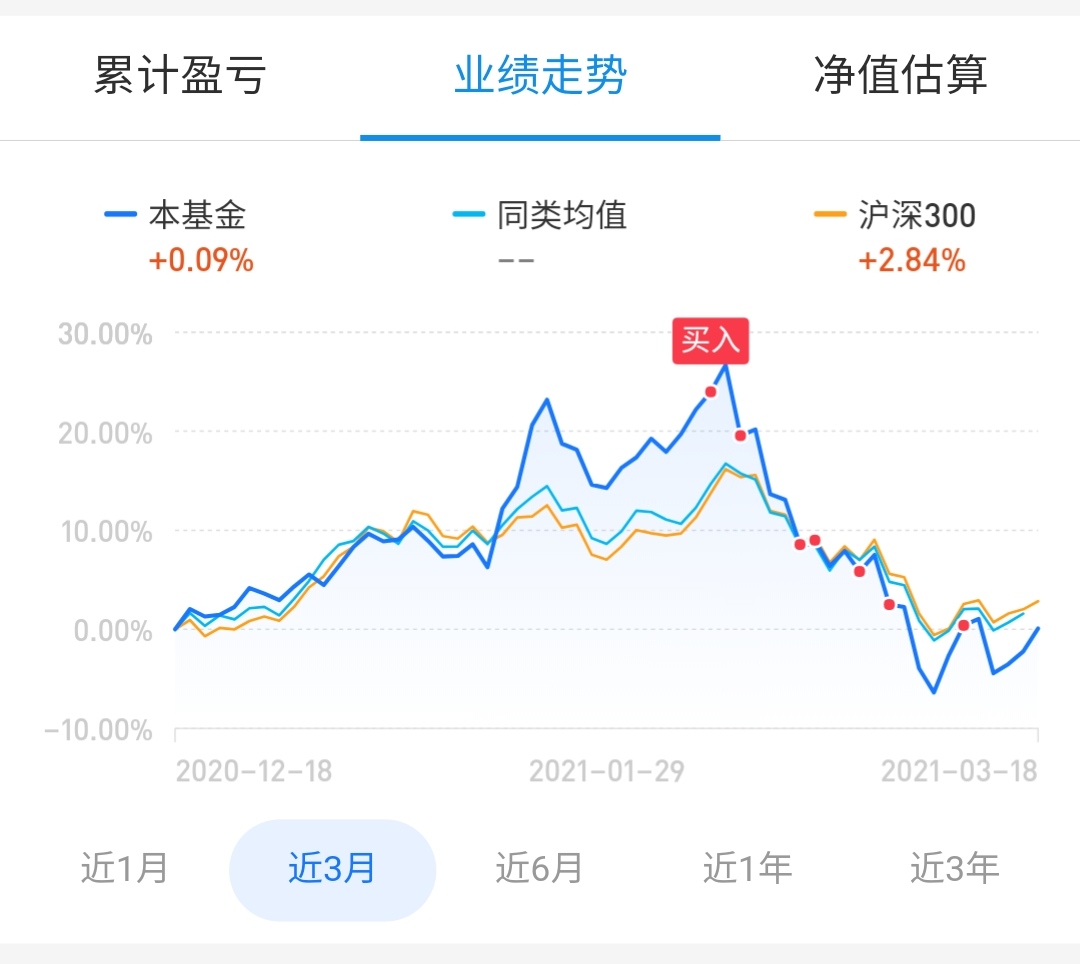
👆 “Be a friend of time.” I comfort myself this way.
After reading “Money Money Money,”
at the start of the year I prepared to learn about investing,
and started using my salary to buy mutual funds.
After buying 10K in January and earning 2%,
I had Mia add another 40K investment,
then I’ve been gliding down from the peak ever since,
collecting countless memes, gifs, and jokes along the way.
Back in the 《Chat With Roommates》 era,
I held an unsophisticated view of financial freedom:
Assume you work 10 years and save up 1M.
As long as my investment return rate can reach 5%,
I’d get 50K per year,
plenty if I’m frugal!
Even considering CPI and stuff,
I can find ways to adjust principal and return rate.
This unsophisticated financial freedom view
has accompanied me to today.
I’ve also gradually patched it more:
First, I probably actually will work my whole life.
Even setting aside self-actualization and only talking money,
a 100K annual salary at a 10% return rate is equivalent to a 1M stable asset bundle.
Second, I really can’t be too optimistic about the return rate.
I might be able to hope for 5% to 10%,
but 10% to 15% or even 20% is a systems engineering problem that needs learning —
after all, Buffett has only managed 20%+ annualized return rate over many years.
Risk Return
Are you content to remain unknown, or do you want to make a splash?
— Jack from Night City
Wealth is fair in some sense.
Some people can live off family inheritance for a lifetime,
others have family inheritance that puts them in debt for a lifetime.
Some use leverage and short-term trading to become a stock god and a legend,
others have a family of five jumping off a rooftop one by one.
All returns come with risks,
every adventure path has a treasure chest.
Critical illness insurance is one type of insurance really worth buying.
Although many companies have included critical illness insurance in employee benefits,
it’s worth spending time researching personally.
There’s an (alarmist) saying:
“A million can cure many diseases.
What a million can’t cure
probably five million can’t cure either.”
Critical illness insurance is a safety net for risk.
Then options and stocks are a safety net for returns.
zettaranc talked about it on Bilibili — his story of long-term bullish holding on Li Ning,
quadrupling his assets.
In my view,
if programmers hope to gain returns at a higher order of magnitude than tens-of-millions,
then options and stocks must be understood.
Whether it’s long-term bullish bottom-fishing in the market,
or in the form of adding value through labor,
finding a small unicorn company
and growing with it.
Position Management
Family inheritance, labor income, investments, and risk return make up one person’s lifetime wealth.
The different position ratios among them
can even influence a person’s view of life, view of the world, and values.
For example, in the wealth composition of “second-generation rich,”
family inheritance accounts for over 90%.
Forget labor income —
operations like investing
having a positive return is already pretty good (see pandaTV).
So for humans whose family inheritance accounts for over 90%,
from a wealth perspective, working hard has zero return.
At this point you either switch to the “self-actualization” value perspective,
or switch to the “I don’t know what to do, but being filial to my parents is the right call” salted-fish mentality.
Then for the “grinder” (neutral term),
why do they throw themselves wholeheartedly into work?
Because maybe they’re a human whose wealth accumulation comes mainly from work salary,
labor income making up a huge portion of total wealth.
Compared to other choices,
clearly putting more into “labor” has higher returns.
My dream is:
World peace,
The ones I love and the ones who love me can all be happy,
I want to become a gentle strong person.
In my heart,
to achieve my dream I need wealth at a much higher order of magnitude than tens-of-millions.
Looking from the time dimension of a lifetime,
family inheritance and labor income are perhaps just a small step in my struggle.
What I really need to do
is maybe to take Zaihui public (x
then one day go found an unfinished cause,
and if possible help the world,
shelter all the poor scholars under heaven so they may all smile.
Miscellaneous Notes
I’m always telling Mia:
“Don’t look at how we’re not rich now,
but we will be rich.”
Mia always comforts me:
“My ambition isn’t as grand as yours.
I’ll try to support you when you get laid off at 35.”
(end)