Runfei’s passing
is a tragedy,
and also a wake-up call.
(I)
Recently every group chat has been flooded with the news of the Pinduoduo employee (online handle “Runfei”) who passed away.
Online sources reveal that Runfei was a girl born in 1998, working at Pinduoduo’s “Duoduo Grocery” business in Xinjiang.
At 1:30am on December 29, 2020, she collapsed on her way home from work, and could not be saved.
This event got amplified even more because of two things:
First, Runfei was not the stereotypical introverted programmer,
but a positive, optimistic operations girl who had played in a band in college,
and her company signature was “Feibao guarding the frontier for Duoduo.”
This made many people, beyond just programmers, also feel for Runfei.
Second, Pinduoduo’s PR did “rumor-denying-as-rumor-creating,”
which triggered Zhihu’s official account to face off against Pinduoduo’s low-level PR.
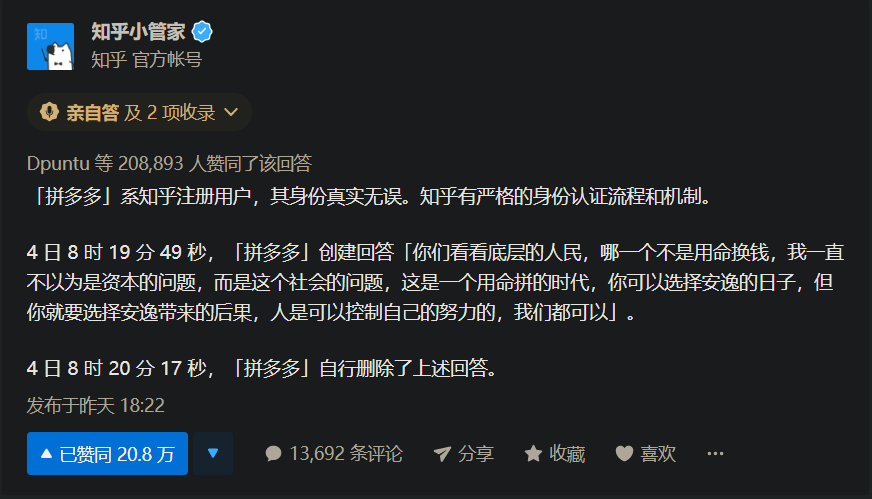
This “history of self-owns” style of operation triggered a carnival among the onlookers,
quickly going viral with absurd behavior.
While it had impact on a wider scale, it also triggered a not-small wave of kitsch behavior.
A week later this whole thing has not been completely forgotten.
On the contrary, it sparked a series of more far-reaching discussions like “anti-capitalist, anti-996”
and “if you die suddenly on the way home from work, does that count as a work injury?”
“This is a far-reaching choice, please choose carefully.”
(II)
From society’s angle, this might be a small butterfly in the river of history.
As netizens grow older, and self-media voices get amplified,
this event, like several other recent events, has triggered similar discussions:
why do people live.
Three years ago Jack Ma was still “Daddy Jack Ma,” but recently he’s been called “capitalist Jack Ma” most often.
A few years ago you could often see press releases about Huawei’s wolf culture or Alibaba’s cultural values, but lately the comment sections of those articles can only be controlled.
Not to mention the “involution” and “PUA” winds that picked up last year — I don’t know whether they can hold a place in the Chinese vocabulary,
or whether like “diaosi” they’ll lose their original precise meaning.
For the long-term impact of big events, we can look at history.
Corresponding to this incident, from recent to distant, I think of three things:
The Pinduoduo coupon incident led to internal company rectification, but didn’t seem to affect society.
The DiDi Yueqing girl murder case prompted reforms in the safety system for ride-hailing and improvements to the regulatory system.
The Foxconn serial suicide tragedy triggered society-wide discussion about “sweatshops,” repromoting the basic idea that “employees are also human beings.”
What kind of effect will this butterfly produce?
I’m not sure.
But it will definitely change a part of society,
maybe part of our consensus,
or maybe part of our way of life.
(III)
From the perspective of an internet industry worker, this is another bloody example.
Mia told me that her company has an unwritten candidate model called:
“Poor, smart, desire to be rich.”
The internet work model is similar,
attracting a large crowd of smart people to work hard at such companies
with the approach of “two people taking the salary of three to do the work of four.”
In Shanghai, Pinduoduo’s salaries are in a class of their own.
Several outstanding candidates we previously interviewed and liked
were all snatched away by Pinduoduo with at least a 50% pay differential.
But speaking of competing in misery, there’s always someone more miserable. For example, students in “bio-chem-environmental-materials” would say:
“We’re not any easier than internet folks, at least you guys make more money.”
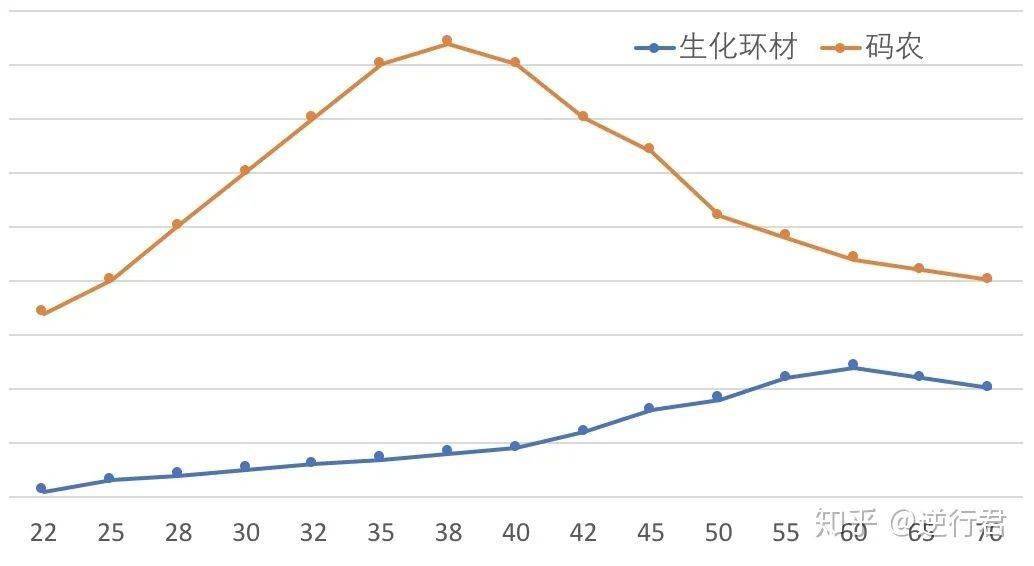
True.
And this is just a horizontal comparison within the same era.
If we compare across eras,
it’s easier to bring the conversation to lamentations like “Better to be a dog in peaceful times than a person in chaos.”
So as the saying goes:
A person’s success,
of course depends on personal struggle,
but you also have to consider the historical process.
(IV)
From a personal angle, if something similar happened to me,
I would feel it’s really not worth it.
In the Zhihu universe there are many brain-teaser questions, one of which is called
《Suppose there’s a game where you can get 5,000 yuan for free, but there’s a one-in-a-million chance of dying on the spot. How many times would you play?》
Rational people’s answer is: “That probability? I can play till you go bankrupt!”
Hearthstone, due to its high randomness,
also often has all kinds of probability-based lethal questions.
Crazy players’ answer is: “The lethal probability is definitely 50%, because either it kills or it doesn’t.”
Of course these are two completely unrelated things.
But in my eyes, the logic of life is the same:
“A person must die. The death may be heavier than Mount Tai, or lighter than a feather.”
I don’t admire behaviors like “calculating the ROI of working 996 for ten years and then walking away,”
but I deeply respect those “most beautiful counter-marchers” who “do what they know cannot be done.”
If the company is part of your career, then struggle for it.
Otherwise, please take good care of your body, so you can throw yourself into a greater revolutionary cause.
Finally, let me quote this passage from Pavel Korchagin as a beautiful wish for everyone:
The most precious thing in life is life itself, and life is given to us only once.
A person’s life should be lived this way:
When he looks back on his past,
he will not regret wasting his years,
nor be ashamed of having done nothing.
At the moment of his death, he can say:
“All my life and all my energy
have been dedicated to the most magnificent cause in the world
— the struggle for the liberation of mankind.”
(end)