Since taking charge of a whole team in late 2017,
all the way until today,
I’ve maintained the dual role of Dev + Leader.
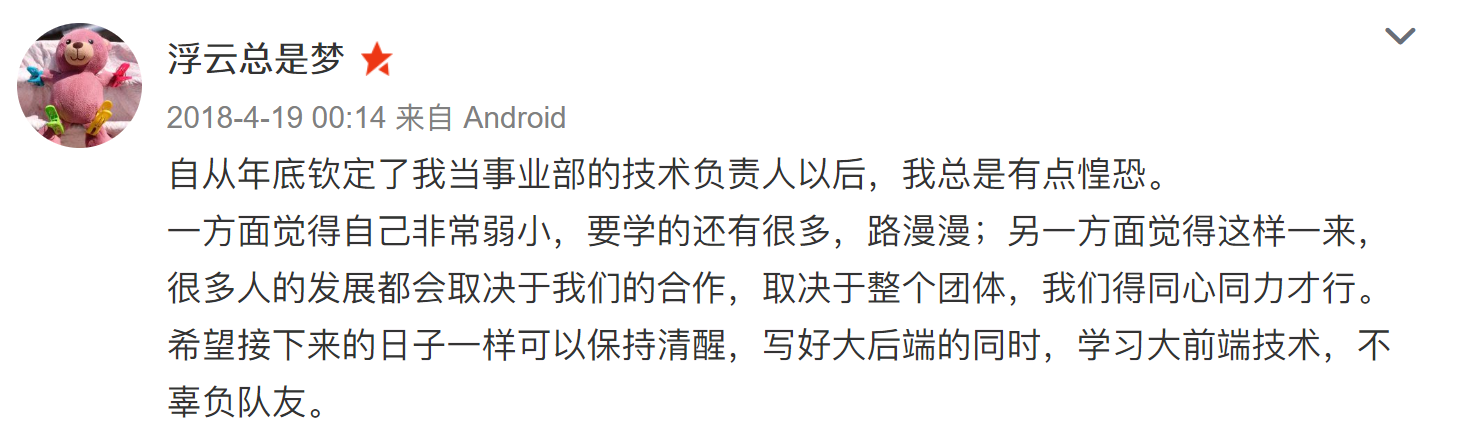
(Prelude)
The last piece was mainly a running account of my scattered memories.
This report I’d like to systematically organize my methodology of dealing with the team. (Or team culture.)
I always think someday given the chance,
I might open up a piece of land of my own,
and at that time I’ll probably also create, lead, and organize a team this way.
Always Aiming - Always Aiming
I really like the dialectical viewpoint about contradiction:
contradictions have primary and secondary distinctions, often grasping and solving the primary contradiction
also resolves the secondary ones.
For example,
the role engineers play in team collaboration flow is a topic I’m very focused on.
The same engineer, when he actively works versus when he passively accepts blame, the difference in effect is huge.
So every time in collaboration,
I try to remind every partner
where the user’s most needed point is, what the business goal is, who needs to do what.
Big projects especially need this kind of calibration.
Many technical difficulties, or seemingly brilliant product solutions,
might not be worth mentioning against the goal.
In the early days of Lianlian Tuan,
we ourselves wrote a Venom system,
provided a full set of real-time data displays,
letting dev, product, ops all easily solve their puzzles.
Later the whole system was refactored with open-source metabase,
evolving into the current Blue Ice internal data overview,
always aiming at goals with quantified numbers.
The same applies
to members’ growth plans.
What’s my team’s hiring goal?
Is it to do work to solve business goals?
Yes. (Laughs)
But not only that. (Serious)
In past practice,
the team’s growth not only came from the hiring philosophy I mentioned in the last report:
Stick to hiring only excellent people, if they don’t know they can learn.
It also came from every team member growing together with the company.
If the team only has hiring standards without growth plans,
then onboarding is the peak.
Luckily, in the past few years,
many excellent classmates joined Zaihui right out of graduation.
Besides technical growth,
I also pay particular attention to their salary increases.
I think most people walked out of the post-graduation strapped state,
as long as we strive to provide an environment suitable for flying,
we can all take off.
In the team growth plans these past few years,
I helped quietly contributing introverted classmates get (specially approved) promotions and raises,
also established fixed internal communication and sharing mechanisms,
and tried irregular 《Human Instrumentality》 email plans to sync company-level goals to the team.
For me, the methodology that first comes to mind in team collaboration is Always Aiming,
in doing anything, finding ways to grasp the primary contradiction.
Keep Laughing - Keep Laughing
The previous section seems too serious, let’s be happy.
This is a sentence that often pops into my head.
There’s also an urban legend among engineers:
life is short, I use Python.
A happy, relaxed environment
gives huge efficiency boosts to collaborative work, especially for brain workers like engineers.
And because work occupies a very large portion,
a laughter-filled job also more easily ignites everyone’s enthusiasm,
or to narrow down to just my own opinion:
I love teams full of laughter.
We added a nickname function to the little bot that reminds us about PRs,
maybe recording the origin of a colleague’s nickname when they joined three years ago;
dev and product banter outside of negotiating requirements
(seemingly at swords’ points but actually flirting.jpg);
we also maintain active non-work messages in the WeChat group,
endless trash memes and broken pictures.
Correspondingly, a happy environment needs a relatively relaxed system.
If a team consists of harsh rewards and punishments, enforced high pressure, forced unified thinking,
then it’s hard for the small flowers of happiness to bloom.
Going further,
the happy atmosphere makes everyone develop friendships beyond work,
and friendships make the team tighter and more united.
Make Friends - Make Friends
@hulucc and I have both organized online game guilds.
One night chatting late, I talked about my views on online game guild stability:
If an organization is hierarchical,
then the organization’s key nodes are fragile.
For example I’ve seen plenty of guilds collapse after the guild leader and core players AFK’d.
To make an organization stable and developable,
the organization must be net-shaped,
so every link is removable,
and also every link is very important.
The way to build a net-shaped organization is simple: friendship.
In the teams I’m in, I don’t necessarily maintain great relationships with everyone.
But I pay attention to whether everyone has found at least one good friend in the organization,
and I’ll deliberately, when divvying up work, have good friends work on the same piece.
Their friendship will get forged in the artillery of fighting side by side.
A net-shaped organization built by friendship,
from the team perspective, is more stable, more efficient, easier to communicate;
from the individual perspective, gains a mutually understanding friendship where you can entrust your back.
Many colleagues who graduated from our company still keep in touch with their good friends,
these, like the tech they learned at work,
will all be wonderful memories and treasured assets for a lifetime.
In actual collaboration, Make Friends and Keep Laughing these two principles complement each other.
Plenty of people have told me they envy our team’s culture and spirit,
but what makes me happier is seeing everyone grow at work,
and find soulmates in life beyond work.
Spread Trust - Spread Trust
In the team’s overall good atmosphere,
exchanging trust is an obvious methodology.
Exchanging trust means not only trusting some particular classmate,
but also trusting the team as a whole.
We give everyone maximum trust in internal permissions, task claiming, and speaking mechanisms.
For example in daily agile development,
just raise your hand and say “I want/don’t want to do this,”
and the Scrum Master will modify the corresponding work split.
Even just by raising your hand and saying “I want to be Scrum Master,” you can become the Scrum Master
(then become a tool-person).
For technical topics engineers care about, it’s the same.
We never solidify any matter.
When new classmates take over projects,
I also repeatedly explain:
“No matter what part of the project you don’t understand or feel is unscientific,
bring it up anytime, let’s figure it out together.”
Another relatively special point is,
in the team I don’t maintain a fixed one-on-one (1:1) mechanism.
Whether big or small matters, business or technical, personal development,
content traditionally suitable or unsuitable for one-on-one,
we sync these messages with the whole team in the fixed weekly meetings.
Practicing the Spread Trust method,
the most intuitive thing I can feel is the high sense of security in the team,
nurturing many partners with ownership.
Because of trust, team work has no worries about looking back,
so everyone can stay Always Aiming together.
Like 《Pearl Birds》 says:
Trust often creates a beautiful realm.
Stay Awake - Stay Awake
Many urban legends say new hires have a honeymoon period at companies.
Setting aside the accuracy of this saying,
indeed work often gets to your head,
and conscientious colleagues working conscientiously get to their heads even more easily.
This is when you need the temperament of “amid universal drunkenness, I alone am sober,”
Stay Awake.
Some examples.
When the team argues,
need to distinguish whether it’s arguing because of viewpoints or because of communication,
interrupt the communication based on the situation.
When doing something that seems 100% certain,
on one hand encourage and affirm the team,
on the other hand prepare for the “old man who lost his horse” outcome and let the bullets fly a while.
When team changes happen and everyone falls into confusion,
go find the most complete information,
use positive thoughts and active attitudes to influence the team.
Most of the time, team work is multidimensional and complex, hard to evaluate one-sidedly;
but individuals, especially groups, always tend toward binary black-and-white logic.
At such times the team needs a brother to step up,
showing everyone the other side of this piece of paper of reality — another possibility.
Even if this piece of paper is perhaps a Möbius strip.
Stay Awake thinking often makes me feel a tearing between myself and the team,
but such dialectics, can truly bring great benefit to the team as a whole.
Never Stop - Never Stop
As time tumbles forward, the process of history roars.
The team as a whole reaches ever more milestones.
Things we usually deal with often have a fixed endpoint.
A movie has an ending,
a project has a launch time,
each year has a performance review.
But in the methodology I believe in,
the team’s forging, growth, development have no end,
and so do individuals in the team.
I tell myself every day: you’re great.
But I never tell myself: you’re great enough.
Even though these years I’ve had to spend a lot of time on management matters,
I’ve also kept my head in the first line of development.
I also put this thought-stamp on myself:
I hope I’m the most technically skilled in the team,
if I’m not,
then even better,
meaning someone else’s talent times effort exceeded mine.
I’ll communicate with peers and friends outside the company,
horizontally learning how to better develop and evolve the team;
I’ll also pause like today and think,
the evolution path of the team I’m in over the past few years.
Whether team or individual,
we’re walking a path of endless cultivation,
with time as a companion, with time as a friend.
(Conclusion)
From the first weekly team meeting in 2017,
I shared my insights on personal striving with everyone.
A person’s growth isn’t isolated linearity,
but a multi-factor multiplication principle.
Let me write the formula:
growth = self x team x company x society x historical process
When we want more growth,
we need to consider not just personal striving, team progress, company expansion, social development,
but also the process of history.
When I want to balance personal striving
with making bigger contributions,
I’ll strive to push team progress, company expansion, social development.
And one day if I’m lucky,
I also hope to participate in the process of history,
and proudly say that line:
If it benefits the country, I shall offer my life,
Why should fortune or misfortune sway me.
(End)