When it was my turn for the weekly company sharing in March,
I talked about this topic.
Just like mastering “meta programming” enables you to write great programs,
I thought if everyone could grasp the technique of “meta sharing”,
then our internal sharing sessions going forward would be a continuous feast.
This article’s tone is closer to a presentation,
the literary quality is a bit lacking.
Background
Today’s topic is “How to Lead the Rhythm”,
we can also say “How to Persuade a Group”,
or “How to Increase Your Influence”.
So clearly,
what I’m talking about today is rather abstract.
Basically it’s all chicken soup (motivational fluff).
About chicken-soup articles/sharings,
there’s a saying:
One man’s arsenic is another man’s honey
I couldn’t really find the source of this saying.
It’s probably an evaluation of Yang Yuhuan.
Speaking of Concubine Yang, one of the Four Classical Beauties,
to the emperor she was honey,
but to the toiling masses she was arsenic.
You can also call this saying “different strokes for different folks”, “carrots and cabbage”, “Hamlet and Lin Daiyu”,
the meanings are all the same.
Hear the truth in the morning, then die in the evening without regret
This saying actually means the same as “knowledge from books is only superficial”.
Often when we hear principles from articles or sharings,
we think they’re quite ordinary.
When we actually put them into practice,
we find they really are scientific.
Back to this saying:
the meaning is that you heard this sharing this morning,
and by evening you’ll be exclaiming “sugoi”.
(Everyone froze, then laughed)
Liking leads to indulgence, but love leads to restraint
This sentence comes from Han Han’s “The Continent”,
he sent a Weibo a while ago:
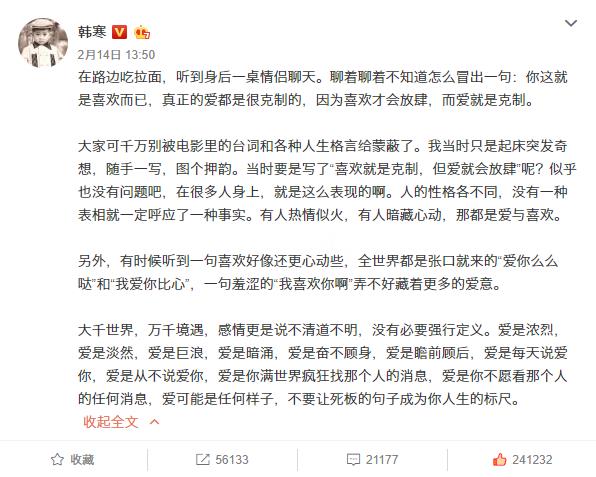
What I’m talking about today is probably also going to be like that.
As they say, “ancient sages were all lonely, only drinkers leave their names”.
Although I think what I’m sharing today is from the bottom of my heart,
just pick the parts you believe.
Theory
OK, background introduction done.
Let’s talk about the theory of “How to Lead the Rhythm”.
Pure theory is dry,
let’s think of an example:
you’re playing an online game (say World of Warcraft),
you joined a very powerful organization (say the top-ranked Onmyoji guild on the server),
you want to have a place in the main roster,
or even lead the team in the end.
How should you do it?
Roughly the four steps are:
- Infiltrate
- Build a persona
- Pay attention to techniques
- Don’t forget your original intention
Infiltrate
First, every organization in the world has its own set of behaviors.
For example, open source projects have their code styles,
each company has its culture,
a guild may have its dungeon schedule.
So the first step is: observe more.
There’s a saying here:
“New Lurk Three”
This means “newbies must lurk for three months first”.
Lurking for three months doesn’t mean you don’t talk for these months.
Rather, under the premise of participating in interactions appropriately,
you have more time to pay attention to things like:
“What are the organization’s slang terms?”
“Who in the organization can you joke with?”
“What style of speaking makes everyone most comfortable?”
“Are people aiming to climb the ranks, or are they aiming for casual play?”
Speaking of which, we can bring up another question:
How to communicate with young people?
I’ve always felt this is bullshit:
just chat with them more,
play the same games they play,
visit the same websites they visit,
and you’ll naturally know what “today’s young people” are thinking.
Many people don’t want to play with kids,
but also want to have common topics with kids.
This is obviously unscientific.
For example, people we’ll talk about later like Local Zuo, Ge Ping are very good at this.
Don’t Pull-Step
This is the literal meaning.
At any time when interacting with people,
we shouldn’t “pull one up while stepping one down”.
For instance, when playing games,
a team might have a fixed roster.
We absolutely cannot, because we want to replace the current tank,
only get cozy with the healer and say “that tank is so-and-so”.
Such an operation, for short-term reward
at the cost of long-term development, is very damaging.
We’re leading rhythm for the long term, not a single moment.
Early A/B Station story
Junru is also an A-island zombie so he might know this more clearly.
Most of you probably only know B Station is great.
But actually back when B Station was founded there were some not-quite-harmonious operations.
The specific situation I can’t be certain of,
but in my eyes there’s suspicion of “pulling oneself up while stepping on the neighbor”.
(Though operations, capital, the young miss, etc. are stories for another time)
Don’t KY
KY, this word comes from Japanese “空気を読めない”,
which translates to “can’t read the air”.
For example,
many people at our company play dota2.
If everyone is excitedly discussing a newly released hero,
and I say: “Am I the only one who thinks dota1 is more fun than dota2?”
That’s KY.
Even if I really think this internally,
I have to say it in the appropriate air (atmosphere).
Pole Spirit (contrarian)
A while ago there was this term,
referring to people who “love being contrarian to the point of becoming demonic”.
For example, if I posted on WeChat Moments today,
saying “wow I wrote a little server with Python flask, so happy”,
and the comment says: “Why not Java? Java is more efficient.”
Or on Weibo when @AragakiYuiNewsAgency posted a nine-grid of beautiful gakki pics,
and fans were all licking their screens,
someone commented: “Am I the only one who doesn’t think Aragaki Yui is very pretty?”
This kind of thing not only destroys the atmosphere,
it also lowers your group status.
Try your best to hold back and not do this.
Don’t Conflict
Literal meaning, just don’t argue with others.
Although honestly this one is hard.
I’ve seen plenty of organizations fall apart because core members argued with each other.
Game
Up to here for the sharing,
I organized an on-site mini-game:Everyone says one KY thing, others rate how KY it is
Because the people present were all R&D coworkers who roast each other normally,
the scene was unusually lively.
(Atmosphere intensified ++)
Build a Persona
The following will sound a bit chuunibyou, please bear with me.
The word “persona” I mentioned,
in English would be stereotype,
i.e. “fixed impression”.
This word’s meaning may inherently be derogatory,
but we should know this is a setting that actually exists.
For instance, when I first came to the company,
having no shared experiences with everyone,
you all surely got to know me starting from some of my personas:
Jiao Da graduate, Boss Liu’s roommate, Cantonese.
So roasting Fudan, roasting Boss Liu, roasting Fujianese are all moves very “in line with the persona”.
The first weakness of human nature we should mention here is:
Mortals All Wish to Control the World
For example, when I moved a while ago,
I discovered something fun about humans (said in a contemptuous tone, everyone laughs).
That is, many people don’t live in the real world,
I feel they only live in their own worldview.
For instance, while moving I’d come into contact with many people,
and each one would ask one question:
“How much are you borrowing this place for?”
(Q: why “borrowing”? A: that’s how Shanghainese people seem to say it)
I always said: “Normal price.”
Note I didn’t directly answer their question.
Then some would say: “Oh, three or four thousand.”
Some would say: “Five or six thousand needed.”
Their question actually wasn’t seeking a real answer,
they were just using various ways to reinforce their own confidence:
“Hmm, as I thought.”
Mortals always want to grasp the rules of how the world operates.
What foolish humans, meow. (everyone laughs)
But here, although we say mortals are such-and-such,
we are also mortals.
Without self-awareness,
we too easily fall into this weakness.
You don’t find out the facts of the matter,
you just keep reinforcing the settings in your head.
(For example, some interviewers decide the interview result based only on first impression)
So there’s an important thing here:
Empty cup mindset
For example, Boss Zhang (the attentively listening Boss Zhang startles),
by GitHub statistics he’s the #1 Python programmer in China (everyone laughs).
He’s not only great at code, when people compliment him he praises them back.
This is the classic empty cup mindset. (everyone laughs, Boss Zhang: don’t deserve it, don’t deserve it)
This empty cup mindset isn’t hard to achieve, but the reverse isn’t necessarily.
For instance me, Lirian Su, I honestly didn’t take “Computer Networks” in college,
when I came to interview at our company I really couldn’t tell Get/Post apart,
if they’d asked me that I would have failed.
So if someone had told me “hey, your network basics are weak”,
without controlling myself I’d easily get angry:
because my network basics really were weak!
So you should not only keep the empty cup mindset when full,
but even more so when the cup is empty, you have to be aware of this fact,
and keep the empty cup mindset.
We Only Know There Are Many Personas
The previous section talked about mortals,
this section talks about us.
Pardon my bluntness,
all of you present are……
elites! (everyone laughs)
Hearing such kind words,
of course we’re happy.
But thinking about it a bit, we’ll know:
we’re no different, we’re mortals.
This is the tricky part of personas:
in language we often say “we are such-and-such”,
but actually I am me, you are you, two totally different people.
As a collective,
maybe ordinary,
but looking at fine granularity,
each person has a completely different persona,
each person’s image is different.
Look Around, It’s Already Like This
The previous section was too abstract.
Let’s look around us,
or among people everyone knows, who has “typical personas”.
Gao Xiaosong
On one hand, I’m speaking in a public setting,
in principle I should be rational and objective.
On the other hand, what I say only represents my personal thoughts.
I feel Gao Xiaosong is somewhat similar to Luo Zhenyu.
Both are liked by certain groups due to certain traits,
but we should know what’s loved is the persona.
For instance on Zhihu there’ll be discussions like “what Gao Xiaosong said is wrong,
Luo Zhenyu’s 60-second voice messages are pre-recorded” and so on.
Most of the time such things don’t affect their public personas.
Ge Ping
(Here I played the original to those who don’t know Mr. Ge Ping,
the classic “Loop”,
also Mr. Ge Ping’s own version of Loop)
Like Local Zuo,
Ge Ping was suddenly given a “strange” persona past his fifties.
But they both happily accepted their personas,
and sometimes generously joke about their own personas.
Many young people initially just wanted to spoof them,
but ended up being charmed into fans by their personality.
Naturally Repeated, Sooner or Later You’re Caught
After this whole long talk,
what I want to express is that the phenomenon of “persona” naturally exists.
As long as we use the persona point well,
we can deceive most mortals.
So how to build this persona?
For instance, there’s an old joke that Lei Feng wrote all his good deeds in his diary.
From my perspective,
if a person can maintain their persona 360 degrees throughout life,
then they are that kind of person.
For most ordinary people,
what their persona is like
basically depends on what kind of person they really are.
When you gaze into the abyss,
the abyss also gazes into you.
You cannot resist.
Game
After explaining personas this section,
those present played another game,
called “everyone tell three of their own personas”.
This session was also extremely lively.
Usually before one person could tell their own persona,
everyone would rush to answer for them.
But something fun happened in the middle.
Boss La said one of his personas is “introverted” (everyone laughs).
Later when Boss La and I were chatting,
talking about heartfelt things,
Boss La said he’s actually not very enthusiastic with strangers.
Many people think he’s very outgoing,
but he himself feels the “introverted” he said in this session is his actual personality.
I couldn’t help falling into thought.
This kind of game session is great.
Not only can it indirectly support the sharing content,
it also triggers genuine reflection.
Very scientific.
Pay Attention to Techniques
The next chapter’s topic is “Pay Attention to Techniques”.
Now we’ve infiltrated, have our personas.
What we face are all sorts of concrete things.
Next we’ll look at some concrete “techniques”,
this part is more practical.
For instance, a small chestnut example: while I’m sharing,
Boss Tang is listening attentively,
nodding silently in approval. (everyone laughs)
There’s a saying that in meeting rooms,
one person silently nodding can increase group consensus,
commonly called being a “shill”.
Boss Tang: I’m not, I didn’t, stop making things up! (everyone laughs)
Logic
Back to the main topic.
From my perspective,
logic is very important in communicating with others.
I don’t require others to be logical,
but I myself must be logical.
With clear logic, things are easier to explain clearly,
and reduces misunderstanding in all senses.
For instance:
Know what you know
This is actually very ordinary wisdom,
but you can observe that many people can’t do it.
This overlaps somewhat with the empty cup mindset above,
so I won’t elaborate.
Let me share a useful little trick.
FFC (Fact, Feeling, Compare)
One human weakness is:
people get happy when praised.
So if we want to influence someone,
a great entry point is to praise them.
This FFC principle
is the principle we can use when praising others.
For example, today my girlfriend made me a meal.
I can say:
“Today’s borscht has such vivid color, smells so fragrant!
(This is Fact)
Just looking at it makes me hungry. I think your cooking is amazing!
(This is Feeling)
I never used to actively eat tomatoes, only the ones you make do I like!
(This is Compare)”
After saying this,
my girlfriend will be very happy,
and tomorrow I can drink the soup she’ll make for me too. (everyone laughs)
This principle is easy to remember.
In the upcoming game session we’ll play “use FFC to praise a teammate”,
everyone can think about it.
Generally speaking,
about praising others there’s another saying,
which is:
Praise publicly,
criticize privately is best.
Very simple.
If today I tell Boss Zhang alone “you’re the #1 Python programmer in China” (everyone laughs)
Boss Zhang gets single helping of happiness.
But if today I say in front of everyone “Boss Zhang is the #1 Python programmer in China”
with N people present,
Boss Zhang gets N helpings of pleasure (everyone laughs)
The super-receptive Boss Zhang: I have so much pleasure (everyone roars with laughter)
Reverse
Just now we talked about positive things.
Sometimes looking at the same thing from the opposite side gives a different view.
For example, I really like an author called “Cai Zhiheng”,
his pen name is “Pizi Cai”,
he’s the author of “The First Intimate Contact”.
In one of his books he mentioned this story:
The Rock on the Right
It’s about a traveler climbing a mountain,
exhausted along the way, but the scenery is also great.
Walking and walking, he came to a fork.
The left path is a flat road you can see all the way down,
the right path is a rock that’s hard to climb.
At this point he thought,
should I take the left, with mundane scenery,
or try climbing the rock on the right?
In the end he chose the flat road.
But all along the way he couldn’t help thinking:
“If I had climbed the rock on the right,
what kind of scenery would I have seen?”
This trope is called “regret in the heart”.
Many films/dramas/anime use this,
like the male lead had blabla some event in childhood,
that affected him for life.
This is great for driving twisty plots.
But I think as a living person,
don’t pay attention to that rock on the right.
Since we chose the left path,
follow that path to the end.
(Speaking of this, I suddenly didn’t know how to continue)
Uh, our sharing topic is supposed to be “How to Lead the Rhythm” right,
how did I get to personal worldview? (everyone laughs)
Forget it, my PPT is already written, continue.
Half-Full Cup
You’ve probably heard this story.
A cup half-filled with water.
Optimists look at it and feel half is still there.
Pessimists look at it and feel only half is left.
Engineers look at it and feel the cup’s volume is twice the rated size.
The principle this classic story shows is also simple:
the angle from which you look at the problem changes the problem.
We wouldn’t say “being an optimist is right” or “you can’t be a pessimist”.
If we want to be able to look at and do things from a higher position,
we have to be able to observe a matter from different angles.
Standing in the Crowd
Phrased in Western terms,
maybe it’s “all beings are equal”.
But from my perspective,
when we normally think about problems,
we absolutely must not rank people as noble or base,
divide people into nine tiers.
Because this hinders us from putting ourselves in others’ shoes,
making our “reverse” thinking only circulate among our “peers”.
For example Brother Jing, I think he’s awesome,
I believe what he says, I only want to discuss problems with him.
But Qiang-ge transferred from product,
I think he’s a noob, I don’t believe anything he says. (everyone laughs)
The example might be exaggerated,
but when you hear it like this you’ll feel something’s off,
right.
Su Shi has a saying:
“Above I can keep company with the Jade Emperor, below I can keep company with the lowest beggar (, and in my eyes there’s not a single bad person in the world)”
I really like this saying.
Empty Cup
Talking about empty cup again,
let me share a story here.
Socrates
This story is fairly classic.
Roughly, someone asked the oracle:
“Who is the wisest person in all Athens?”
The oracle said it’s Socrates.
After hearing this, Socrates was shocked.
He said: “That’s not right, I feel I’m very ignorant.”
In the end he discovered
that precisely because he was aware of his own ignorance,
he was better than many people on this point.
Corresponding to one’s own weakness,
there’s also another situation we often encounter, which is life’s adversity.
There’s a word here, called “AQ” (Adversity Quotient).
Of so-called IQ, EQ, AQ,
IQ is how to handle logical problems,
EQ is how to handle interpersonal problems,
AQ is roughly how to face adversity.
Humans can’t change the environment in an instant,
so often when facing adversity,
essentially we’re dealing with our relationship with ourselves.
Hunan people have a great saying:
“Stay tough through bullying, endure through annoyance”,
roughly meaning “indomitable perseverance”.
Modesty in Fullness
Another point on empty cup is being modest when full……
(Article was written several weeks after the sharing,
so this section was actually where the above example was supposed to be…
But that doesn’t matter now, moving on.)
Don’t Forget Your Original Intention
Wrapping up,
we’ve talked so much about “How to Lead the Rhythm”.
If you go back and try to use it,
you’ll find one thing:
“The first people you can lead the rhythm of are the people around you.”
For example, Boss He wrote a blog post in 2016,
in it was a sentence “In 2017 I need to supervise my girlfriend in cultivating correct values”.
This shows he was very capable of leading his girlfriend’s rhythm.
Besides between partners, parent-child relationships are also easy to lead rhythm in.
For another example, I often watch various interviews with my girlfriend,
and sometimes people inside say:
“The way I am now,
is because when I was little, my parents did blabla,
which caused permanent damage to me.”
So if you have the ability to lead rhythm,
you must remember two things:
- Don’t forget what rhythm you want to lead
- Don’t forget what kind of person you are
For example, going back to the beginning,
we were playing an online game,
we joined a very powerful organization,
what’s our purpose?
That’s right, our purpose is to make the main roster in the team,
or even become the team leader.
That’s our initial “original intention”.
Practice
Talked through a lot of principles,
the rest is putting them into actual practice.
There’s a saying in The Zen of Python,
let me leave it with you at the end:
> Now is better than never.
>
> --- The Zen of Python, by Tim Peters
(End)
This article’s slides are at liriansu.com/slides/influence
All content is the author’s second-pass digestion of various odds and ends.