Compared to “a language”,
“a programming language” is more often “a convention”.
(Of course, “language” itself is “convention”.)
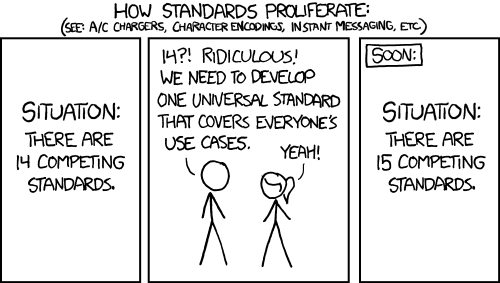
Last time we talked about wanting to be lazy when writing code,
figuring things out, thinking clearly before writing is one way to address the root.
But mortals’ (no typo) requirements are never the main point,
to be lazy when writing programs,
ultimately you still slack on the code itself.
Best Practice
Foreign programmers love muttering a term,
called Best Practice.
For example how JSON should be handled in Java,
you can search Java JSON Best Practice;
for example I know nothing about databases,
but I want to learn,
I can search Database Best Practice;
for example I’m the client,
I don’t know what I want myself,
I can also search Requirements Best Practice.
This kind of English term generally has a direct Chinese translation,
called 最佳实践,
which sounds super stupid.
But it’s very useful for giving examples.
When I joined Zaihui,
I’d only written a bit of Python,
my coding habits were not adding encoding,
not knowing from __future__,
writing print without parentheses,
all third-party libraries I needed installed in the global site-packages.
After coming here I learned about virtualenv.
Later when Boss Zhang was playing with Lucene I set up Gradle for him,
and explained: “This thing is simple, similar concept to virtualenv.”
Boss Zhang sighed:
“Actually learning a language starts from these tools,
this way I have a feeling of having gotten started!”
There’s also things like Go language’s gofmt command,
this command forces a unified code style adjustment,
can’t be configured, can’t be customized, indentation uniformly uses Tab.
I was extremely tortured,
but I also recognized the thinking here:
“Language style is just Lin Daiyu Hamlet, a thousand people a thousand faces.
Compared to perfect style, unified style is more scientific.”
Best Practice is the guide during actual operation,
understanding, mastering, practicing Best Practice can write much less code avoid many detours,
solve real problems with elegant methods.
Elegant Methods
Following the routine, next I should talk about an elegant method.
But your humble brother has no elegant method,
so I can only use myself as a counter-example.
When writing API,
you often handle URL,
handling URL is actually string concatenation.
For example in Python converting a dict to query string format,
I used to write it like this:
params = {'name': 'afu', 'action': 'take a plane'}
query_string = '&'.join(['{}={}'.format(k, v) for k, v in params.items()])  # 'name=afu&action=take a plane'
At the time I felt good about myself,
thinking Python is Python after all,List Comprehension is so elegant, so pretty.
However this code not only has a bug,
actually Python has a dedicated library urllib to handle this kind of problem,urllib has also considered various edge cases (like with illegal characters etc.):
# Using Python 3 as example
import urllib

params = {'name': 'afu', 'action': 'take a plane'}
query_string = urllib.parse.urlencode(params)  # 'name=afu&action=take+a+plane'
Later I also learned that urlencode function’s location is different in Python2 and Python3,
typically use six this library to handle compatibility.
The following code doesn’t need extra explanation Using Python 3 as example:
import six

params = {'name': 'afu', 'action': 'take a plane'}
query_string = six.moves.urllib.parse.urlencode(params)  # 'name=afu&action=take+a+plane'
Even though there are many methods that achieve the same effect,
in software engineering,
people often pin down a Best Practice and follow it.
This way not only saves the effort of writing programs,
but also saves the effort of communicating and arguing.
Just as Zen of Python says:There should be one-- and preferably only one --obvious way to do it.
I used to be very curious why most people use import datetime+datetime.datetime(), datetime.date() when writing Python datetime types,
I was perplexed,
isn’t from datetime import datetime, date+datetime(), date() better?
And the subsequent code is shorter.
Later when I read Kenneth Reitz’s Hitchhiker's Guide to Python I understood,Explicit is better than implicit is reflected by explicitly specifying the package name,
this way the code’s expressiveness is stronger, and more readable.
## Very bad

[...]
from modu import *
[...]
x = sqrt(4)  # Is sqrt part of modu? A builtin? Defined above?


## Better

from modu import sqrt
[...]
x = sqrt(4)  # sqrt may be part of modu, if not redefined in between


## Best

import modu
[...]
x = modu.sqrt(4)  # sqrt is visibly part of modu's namespace
Since learning this,
I’ve made up my mind never to use from datetime import datetime again.
Summary
This thing called Best Practice,
looks beautiful,
used well can hugely slack off reduce workload.
But it has one important characteristic:Best Practice is never tried out,
but pondered, learned, selected to be obtained.
Adding one more if, one more machine, hiring one more person, working a bit more overtime,
can probably only solve the immediate problem.
Learning one more bit each day,
that’s how, when problems need solving,
facing the multiple pressures of tech, business, deadlines,
you can elegantly use Best Practice to solve the problem.
In summary,
to slack do less improve efficiency,
we set down these small goals:
- Learn one more
Best Practice - Use it once you learn it, use the elegant method over the stupid one
- Learn through thinking, not entirely through trial-and-error feedback
After all, programming style can’t be shotgun programming.