I often hear other programmers say:
Ahh, found another fun project on GitHub.
So the question is,
how did they find it?
What is GitHub
There’s a highly-upvoted answer on Zhihu written really well,
called How to use GitHub? - Shanshan’s answer
But the pictures inside are a bit outdated,
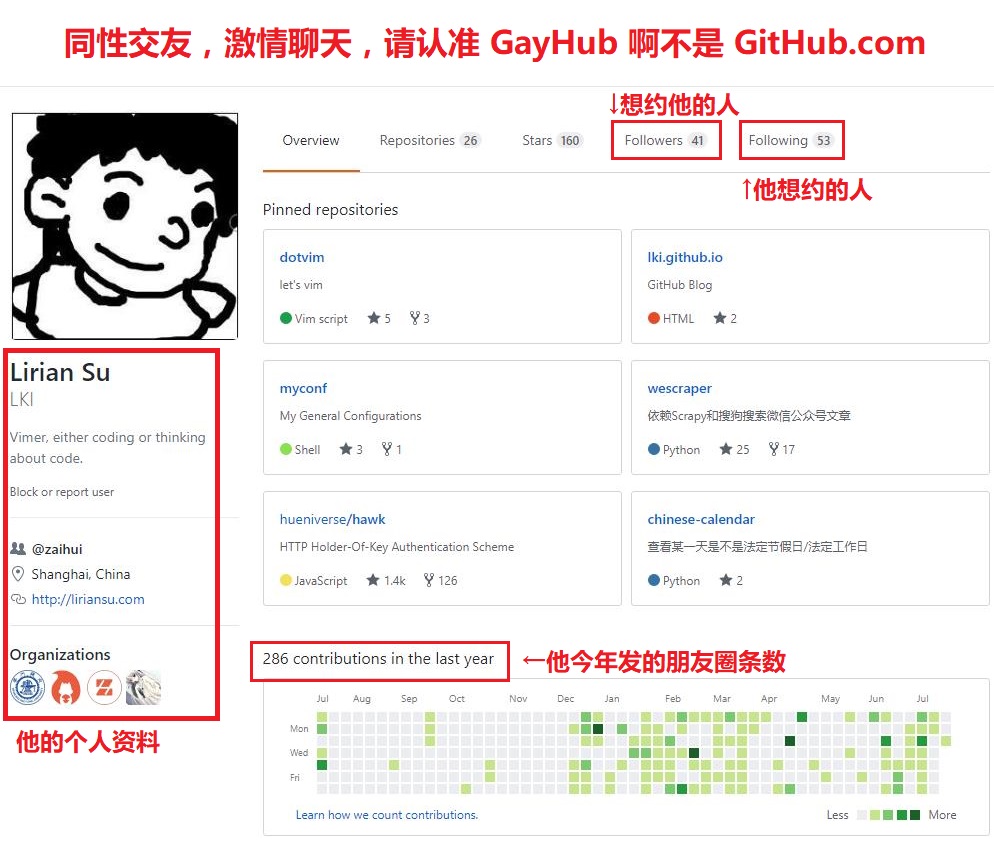
the new version of GitHub looks roughly like this:
Academically speaking:
GitHub is a software source code hosting service using Git for version control,
it is the world’s largest code-storing website and open source community.
Simply put:
GitHub is where programmers put programs.
The put here doesn’t just mean to deposit or place,
it also means to release, to share.
Ordinary programmers put the spare-time tools they wrote on GitHub,
Artsy programmers treat GitHub as a place to write blogs,
Idiot programmers upload their company’s commercial code to GitHub…
What’s fun about GitHub
So since GitHub is where programmers put programs,
it sounds so serious,
how could it possibly be related to fun?
That’s a great question.
In my eyes,
all programmers are adorable creatures,
there’s a term called Programming Humor,
translated into Chinese it’s roughly the fun of code.
For example the XKCD comic series I love a lot
has lots of fun jokes about code:

(I rolled the dice myself with my own skills and got a 4,
why are you saying this number isn’t random enough?)

(Python is great!)
GitHub also has lots of fun stuff.
For example the etilqs joke:
There’s a small database software called SQLite,
it’s super easy to use.So the well-known antivirus software McAfee used this database,
McAfee also put a lot of files on the C drive with sqlite_ filenames.Users who don’t understand computers, after installing McAfee, found
a lot of strange files appeared on the C drive.So some of them Googled and found the phone number of sqlite’s research engineer,
called him in the middle of the night to wake him up,
asking what those extra files on the C drive were for…Later sqlite decided to change the temp file names to etilqs.
If anyone can tell that this word
is sqlite spelled backwards,
then with their intelligence,
they wouldn’t have called sqlite’s research engineer in the middle of the night…
For example a while back,
when several companies were in the news,
there was a programming-job-blacklist project,
listing a bunch of blacklist companies for programmers job-hunting
(the list is just compiled, consume cautiously)

Of course,
there’s also the cool “be a man and don’t break your Contributions for a year” project for grinding Contributions.
In one minute you can become green and glorious:

So how do we play with GitHub?
As Lu Xun said:
where there are people, there will be jianghu.

As a UGC-based website,
we of course need to follow more users.
I mainly follow three kinds of users on GitHub (this classification is not orthogonal):
Generally-recognized big shots, follow these to show worship.
For example Kenneth Reitz, the Python programmer who went from fat guy to handsome guy,
you can often see which organization has pulled him in,
which project he’s contributing code to.Project authors, article bloggers, the things these people do tend to look more fun.
For example Senior Sister Xianzhe,
not only occupying a super good GitHub ID,
much of my understanding of frontend has been swept onto my feed by Xianzhe and You Da.
For example Hao Ge,
although he seems busy making moves lately,
he’s after all an exemplar who’s been fighting on the code-writing front line all along.Friends around me whom I like, normally have more possibilities for technical exchange.
For example my bro ldsink,
some of toolbox’s scripts are super useful.
For example SJTU magician hcz,
lots of fun projects were swept into my timeline by him.
So to summarize.
GitHub is a website that was originally for putting programs,
but has been played into a same-sex dating social network…
(Hm, this article talked about GitHub from a joke-telling perspective)